






Trackday Nordschleife 2026: Nürburgring Guide


Track day Nordschleife – your guide to the legendary Nürburgring Nordschleife
The Nürburgring Nordschleife in the Eifel is more than a circuit – it is a legend. 20.832 kilometres of pure adrenaline, 73 corners and elevation changes of over 300 metres make the “Green Hell” the most demanding track in the world. The Nürburgring has been writing motorsport history since 1927.
A track day on the Nürburgring Nordschleife is on the bucket list of every serious driver. And the best part: you do not have to be a professional. With the right preparation, a structured track day format and experienced coaches, the Nordschleife is within reach for newcomers too.
This article is part of our comprehensive track day guide – there you will find all the basics on track days, the different formats and the circuits.
In this guide you will find everything about track days on the Nürburgring Nordschleife: dates, what drives the price, the difference from tourist drives – and why the ESC format with two groups running alternately delivers the exclusive experience.
What is a track day on the Nürburgring Nordschleife?
A track day is fundamentally different from the public tourist drives. There, many vehicles are out at the same time – from motorbikes to coaches – while on a track day the circuit belongs to a registered field.
The day normally starts around 08:00 with a compulsory briefing and ends around 16:30. In between, running is in assigned groups, with coaching throughout the day. The field is limited, so traffic stays manageable – you can work on your line instead of threading through strangers.

Nürburgring Nordschleife and Grand Prix circuit – the difference
The Nürburgring consists of two circuits that are often confused:
- Nordschleife: the 20.832-kilometre circuit with 73 corners, extreme elevation changes and the notorious Döttinger Höhe. Most track days run here.
- Grand Prix circuit: the modern 5.148-kilometre course with 15 corners, used by international series. Quicker to learn, with generous run-off and full pit infrastructure.
- Combined layout: at individual events both circuits are joined into one continuous lap – the configuration the Nürburgring Endurance Series (NLS) also uses. That makes almost 28 kilometres in one go.
For most track day drivers the Nordschleife is the goal. The Grand Prix circuit is a good place to start – but the real “Green Hell” only happens in the Eifel.
Tourist drives or track day – what is the difference?
Many people confuse tourist drives with track days. The difference is considerable:
| Aspect | Tourist drives | Track day |
|---|---|---|
| Access | public, anyone can drive | registration required |
| Field | many vehicles at once, mixed | limited and assigned |
| Vehicles | from motorbikes to coaches | road-legal sports cars |
| Support | none | briefing and coaching |
| Charging | per lap | per day |
| Track time | within opening hours | all day, normally 08:00–16:30 |
When tourist drives? When you want to sample the Nordschleife without much preparation.
When a track day? When you want to drive seriously, learn and really experience the circuit.
The Nordschleife at a glance
Circuit profile · Nürburgring Nordschleife
The best-known sections of the circuit
- Hatzenbach
- Flugplatz
- Fuchsröhre
- Adenauer Forst
- Karussell
- Döttinger Höhe
The key sections of the Nürburgring Nordschleife
Hatzenbach: right after the start and finish line. A technical sequence of corners where the field sorts itself out – get flustered here and you lose the rhythm for the whole first sector.
Flugplatz: one of the most notorious places on the Nordschleife. Over the crest the car goes very light at speed – a section that asks for trust in the track.
Fuchsröhre: a fast downhill run with pronounced compression at the bottom. One of the places where the gap between “managing” and “nailing it” is largest.
Adenauer Forst: a corner combination in the woods, often damp long after the rest of the circuit has dried.
Karussell: the iconic banked concrete bowl – an experience no onboard video really captures.
Döttinger Höhe: the long high-speed straight at the end. Depending on the car, 250 km/h and more is possible. At our events it is normally run without interruption – what applies on your date is set out in the event description.

Track day dates on the Nürburgring Nordschleife
The track day season on the Nordschleife usually runs from late March to mid-November. In winter the circuit is closed because of the weather in the Eifel.
Various organisers run track days on the Nordschleife, and the field sizes differ considerably – if you are looking for clear track, check the participant limit before booking. At ESC two groups run alternately, normally with 40 sports cars per group.
Popular dates book out early – if you have a particular day in mind, register in good time. All current dates are in the track day overview and in the event calendar.
What does a track day on the Nürburgring Nordschleife cost?
The cost of a track day varies widely – depending on what you expect. These factors set the price:
- Format and duration: a day on the Nordschleife, the 24h variant including the Grand Prix circuit or a date on the GP course are all calculated differently
- Number of participants: the smaller the field, the more clear track – and the more involved the organisation
- Included services: coaching, overnight stay, catering and a service team on site
- Your own car or CarForGo: adding a car costs more, but saves you the preparation, the wear and the drive home
For a sense of scale it helps to look at the public offers the Nürburgring itself publishes: tourist drives on the Nordschleife are charged by the lap, on the Grand Prix circuit by driving time, and there are season tickets for regular drivers. The current rates are listed at nuerburgring.de.
On a track day you pay for the whole day instead – but with a compulsory briefing, assigned groups, coaching and a service team in the paddock.
The current price for your preferred date, and the services included with it, are shown with the individual event in the track day overview. What counts is the description given there and our terms and conditions.
What is included on most dates?
One lap of the Nordschleife measures 20.832 kilometres – a day like this takes a corresponding amount of time, material and organisation. On most dates the following is therefore provided:
- The full driving day on the Nordschleife, normally 08:00–16:30
- Compulsory briefing and circuit introduction before the first group goes out
- Coaching by experienced instructors – in the STARTER window in guided laps, in the EXPERT window as feedback between the sessions
- A single room for the night before, so the drive into the Eifel does not land on the morning of the driving day
- Catering on the track day: cold snacks and a hot meal
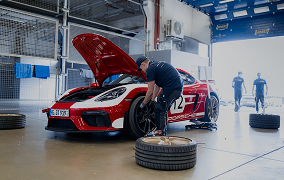
- A service team in the paddock for tyre pressures, wheel changes and vehicle checks – no minor matter at a good 20 kilometres per lap
- On many dates: a free rebooking option and the optional ESC comprehensive guarantee
An organised driver's dinner is available at extra cost. What applies to your date is set out in the relevant event description.
How the day and the groups are split
On the Nordschleife two groups run alternately. The overview below describes the usual case – individual dates may differ.
| Format | Structure | Limit | Sessions |
|---|---|---|---|
| Track day Nordschleife | 08:00–16:30, two groups alternating | 40 sports cars per group | STARTER and EXPERT |
| 24h variant INCL. GP CIRCUIT | 08:00–16:30, two groups | 60 sports cars per group | STARTER and EXPERT |
Which format runs on a given date is set out in the description of that event.
STARTER and EXPERT – which group suits you
Unlike the other circuits, the windows on the Nordschleife are not called STREET and RACE but STARTER and EXPERT. The reason is simple: racing cars are not admitted at our Nordschleife events. Everyone runs road-legal cars.
STARTER is the window for anyone who does not know the circuit yet, or barely knows it. Running is in guided laps: a coach shows the line and sets a pace that suits the group. Many participants already have laps of the Nordschleife behind them and still use this window – for the structure and for running together.
EXPERT is the window for drivers with Nordschleife experience who want to work at their own rhythm in free laps. A coach can be added here at any time too.
Because the groups alternate, never all cars are on track at once. Newcomers get the support they need, experienced drivers get clear laps.
Our tip: for your first track day on the Nordschleife, book a format with coaching included. An experienced coach makes the difference between “surviving” and “learning”.

ESC Nordschleife Premium – the exclusive format
What makes the ESC track days on the Nordschleife stand out?
Maximum track time, minimal traffic
Because the two groups run alternately, the whole field is never out at the same time. Across 20.832 kilometres, whatever is on track spreads out so generously that clear laps tend to be the rule rather than the exception – exactly what separates a track day from a tourist drive.
| Aspect | ESC Nordschleife Premium |
|---|---|
| Groups | STARTER and EXPERT alternating |
| Field size | normally 40 sports cars per group |
| Döttinger Höhe | normally run without interruption |
| Open pit lane | on some dates in the afternoon |
| Noise | normally 98 dB |
| Vehicles | road-legal, no racing cars |
| Usually included | coaching, overnight stay, catering, service team |
What counts is always what is listed for your specific date.
Premium partners and organisation
ESC runs the Nordschleife events together with well-known sports car dealerships and partners from the region. For you that means a well-thought-out setup, experienced coaches and contacts who are actually there in the paddock.
Coaching on the Nordschleife
On no other circuit is track knowledge worth as much as it is here. Nobody gets 20.832 kilometres and 73 corners into their head in one morning – working the Nordschleife out on your own is a project that runs for years. That shortcut is exactly what coaching provides, and it is normally included in ESC track days.
A coach translates the circuit into markers you can hold on to: which crest is blind and still taken straight, where the camber tips away, which corner is only fast because the one before it ran cleanly. In the STARTER window that happens in guided laps, in the EXPERT window as feedback between the sessions. Whether the coach leads the way, sits in the seat next to you or works with you over the radio depends on the format and on how your day is going – he stays reachable throughout.
As a rule, up to six guests share one coach from a crew that brings world championship titles, Le Mans class wins and factory driver careers at manufacturers such as Porsche, Audi, Ferrari and Mercedes-AMG. How the support is arranged on your date is set out in the relevant event description.
Our recommendation for a first Nordschleife day: let the coach drive a lap in your car before you start building pace yourself. Seeing the circuit once from the passenger seat sorts 73 corners faster than any onboard video.

No sports car of your own? Renting a car for the Nordschleife
For most guests the Eifel is a few hundred kilometres away – and the car has to get home again after the track day. If you would rather keep those two things apart, add CarForGo: ESC brings a prepared car to the Ring, on most dates including insurance, brake and tyre wear as well as a mechanic in the paddock.
On the Nordschleife these are road-legal sports cars – racing cars are not admitted here, so the choice differs from the one on the Grand Prix circuit. Which cars are ready on your date is shown when you book and in the fleet overview. What is included in each case is set out in the description of the event and in our terms and conditions, which take precedence.
The side effect counts for more on this circuit than elsewhere: one lap of the Nordschleife is a good 20 kilometres, so brakes and tyres do noticeably more work over the day. With a car provided you drive home relaxed in the evening instead of checking pad thickness and tyre wear first. Bringing your own car is just as good a choice – plenty of guests do exactly that, because they want to work on their own car.

How your track day on the Nordschleife runs
The day starts early with check-in, scrutineering and the drivers' briefing – attendance is mandatory. After that the groups run alternately, interrupted by breaks for fuel, tyre pressures and a look over the car. How many laps you end up with depends on the format, the breaks and the car – track time across the day is plentiful.


Preparing for your Nürburgring Nordschleife track day
Requirements: what you need to bring
- A valid driving licence – no racing licence required
- A road-legal car with valid registration plates. Bring the vehicle documents
- Technically sound condition, no leaks – oil or coolant on track means exclusion
- The noise limit is normally 98 dB. The figure that counts is the one in the event description
- Helmet: a helmet is mandatory on the circuit, on the Nordschleife as anywhere else. Ideally bring your own – it can also be hired through us on request
- Enough brake pad material and fresh brake fluid – a good 20 kilometres per lap ask a lot of the brakes
- Comfortable closed shoes, long trousers and a long-sleeved top
- Companions are welcome, minimum age 16

Vehicle check
Your car has to be in perfect technical condition. The Nürburgring Nordschleife puts extreme demands on cars.
- Brakes: check pad thickness, fresh brake fluid
- Tyres: tread depth, age, no damage
- Fluids: check oil and coolant levels
- Check for leaks – the most common reason for a day ending early
- Remove loose items from the cabin
Know the rules
- Belt up, every time
- Overtaking on the left only, after eye contact and with a signal
- Watch the flags: yellow means slow down immediately and no overtaking
- Drive consistently, no abrupt manoeuvres
- Leave your ego at home – overestimating yourself here is expensive
Simulator training
The Nordschleife does not forgive surprises. 73 corners, blind crests, bumps – anyone who does not know the circuit ends up either dangerously slow or dangerously overconfident.
Running 50 to 100 laps in a simulator before your first track day – in Assetto Corsa or iRacing, say – means you recognise corner entries and crests instead of seeing them for the first time. It is no substitute for real track experience, but it takes a lot of the overload away.
Just as useful: build technique where mistakes stay harmless. At the driver training at the Boxberg proving ground, load changes and wet surfaces can be repeated as often as you like.
Insurance on the Nürburgring Nordschleife
There is hardly a circuit where a look at your own policy pays off as much as it does here. The reason lies in the layout: the armco stands close, run-off is tight, and a mistake in the Fuchsröhre ends differently from one in the generous run-off of a modern course. Anyone heading out onto the Nordschleife should know beforehand what is covered.
ESC's organiser liability normally covers participant liability. Whether your own comprehensive policy covers damage on a closed circuit is best confirmed in writing in advance – many policies exclude events of this kind, and some name the Nürburgring explicitly. In addition we offer an optional ESC comprehensive guarantee for many dates. An excess still applies.
The second point comes down to the Eifel itself: the weather there turns quickly, and for most guests the journey is a long one. On many dates there is therefore a free rebooking option, typically once, up to eight days before the start of the event, onto another date with places free in the same calendar year.
The services, deadlines and cover that apply to your specific date are set out in the description of the individual event and in our terms and conditions, which take precedence.
Nordschleife or Grand Prix circuit?
Both are in the same place and yet they are two different jobs. The Grand Prix circuit, at 5.148 kilometres and 15 corners, can be worked out in a day, has generous run-off and admits racing cars in the RACE session. The Nordschleife is four times as long, far more tightly bounded, and stays reserved for road-legal cars.
If you want to build up methodically, start on the Grand Prix circuit and bring clean forward vision to the Eifel. If you already know the Nordschleife, the combined layout puts both circuits into one day.

Your track day on the Nürburgring Nordschleife is waiting
The Nürburgring Nordschleife is doable – for newcomers too. With the right preparation, a structured format and experienced coaches you will not just get through the “Green Hell”, you will enjoy it.
Two groups alternating, a limited field, coaching and a paddock where someone helps when something jams – that is the difference from a lap of tourist driving.
All upcoming dates are in the track day overview. Our track day FAQs answer the rest.
Want to give the Nordschleife as a gift? A track day voucher suits anyone who takes motorsport seriously.
Questions about your first track day? Get in touch – and read what our participants say.
Frequently Asked Questions about the Nordschleife Trackday (FAQ)
The Touristenfahrten season runs from March to November. Opening times vary depending on weather and events. On Track Day dates, the circuit is closed to Touristenfahrten.
Yes. You need a valid driving licence and a road-legal car in sound technical condition; a helmet is mandatory on the circuit. Previous circuit experience helps but is not required – that is what the STARTER group with guided laps and coaching is for.
For Touristenfahrten yes – with a valid driver's license and a road-legal vehicle. For Track Days, prior registration is required, but in principle any driver with a license can take part.
The Nürburgring is the entire complex in the Eifel. The Nordschleife (20.8 km) is the legendary old circuit. Alongside it, there is the modern Grand Prix track (5.1 km). Together, the two make up the "Nürburgring".
That depends heavily on driver, car and conditions. Someone learning the circuit takes considerably longer than a practised driver in the same car – and a track day is not about the clock anyway, it is about clean laps. In the guided STARTER laps the coach sets the pace.
Tourist drives are paid by the lap, a track day by the day – and you get considerably more laps plus briefing, coaching and support. What a specific date costs and which services are included is shown with the individual event; what counts is that event description and our terms and conditions.
Still have questions?
Contact our team — we'll help you find the right cover for your next track day. Or sign up for our exclusive ESC newsletter and stay up-to-date!


