




Trackday Nürburgring: Grand Prix Circuit Guide


Nürburgring track day: dates, costs and coaching on the GP circuit
The barrier lifts. Ahead of you lie 5.148 kilometres of asphalt on which world championships have been decided. Your pulse rises – and soon your right foot does too.
This guide explains how a track day on the Nürburgring Grand Prix circuit with the European Speed Club works: how the day is split, which sessions are run, what the coaching delivers and what you need to bring. It is part of our track day guide, which covers the basics on formats and circuits. Current dates are always in the track day overview.
What is a track day at the Nürburgring?
There are worlds between a track day and the public tourist drives. There you share the circuit with an open field of very different cars, with no briefing and nobody looking after you, and you are billed by the lap.
On a track day the circuit belongs to a registered field of entrants. The day starts with scrutineering and a compulsory briefing, after which you run in assigned groups – with coaching throughout the day and a service team in the paddock. You do not just get to know the circuit, you work on it.
| Aspect | Tourist drives | Track day |
|---|---|---|
| Access | public, open to everyone | registration required |
| Field | many cars at once, mixed | limited and assigned |
| Support | none | briefing and coaching |
| Billing | per lap | per day |
| Track time | within opening hours | all day, as a rule 08:00–16:30 |

The Grand Prix circuit at a glance
The Grand Prix circuit is not just any race track. It holds FIA Grade 1 certification – the classification given to circuits cleared for Formula 1 or WEC racing. Today's layout was built in the mid-eighties as a modern counterpart to the old Nordschleife and is still used in international motorsport.
For track day drivers one thing matters above all: 15 corners across 5.148 kilometres mean a great many repetitions per session. You get the same corner often enough to genuinely work on it – on the 20.832 km Nordschleife the same learning step takes considerably longer.
Circuit profile · Nürburgring Grand Prix
The best-known sections of the circuit
- Mercedes Arena
- Schumacher S
- Ford corner
- Dunlop hairpin
- Bit curve
- NGK chicane
The key sections of the circuit
Mercedes Arena: the first real task after the start-finish straight. A tight sequence of corners in which the line you take decides your pace through the whole first sector.
Schumacher S: a fast left-right combination that asks for precision and confidence – and comes to you far quicker with coaching than on your own.
Ford corner: the slowest point on the circuit and at the same time one of the most important. Get the exit right and you carry speed onto the straight that follows.
Dunlop hairpin and Bit curve: two places where patience pays. Back on the power too early and the car pushes wide over the front axle.
NGK chicane: the last braking zone before the start-finish line – this is where most of the overtaking happens, and most of the mistakes.

How the day and the sessions are split on the GP circuit
The usual case on the GP circuit is two groups running alternately. Alongside it there is the AFTERWORK format in the late afternoon. The overview below describes the usual case – individual dates may differ.
| Format | Structure | Limit | Sessions |
|---|---|---|---|
| Track day GP circuit | 08:00–16:30, two groups, 5 × 40 min | 20 sports cars per group | STREET and RACE |
| AFTERWORK LATE AFTERNOON | 16:30–20:00, open pit lane | 30 sports cars | run together |
Whether your preferred day runs the full-day schedule or the AFTERWORK format is set out in the description of that event.

STREET and RACE – which session suits you
STREET is the window for road-legal cars: newcomers, cars from the CarForGo programme and anyone out with private coaching in their own or a provided car.
RACE is the faster window. Racing cars on slicks run here – and so do very quick drivers in road cars. The split follows pace, not the vehicle alone.
On the Nordschleife the windows go by different names: there the split is into STARTER and EXPERT, because racing cars are not admitted at Nordschleife events.

Grand Prix circuit or Nordschleife?
We hear that question regularly. The answer depends on what you want out of the day.
| Aspect | Grand Prix circuit | Nordschleife |
|---|---|---|
| Circuit length | 5.148 km | 20.832 km |
| Corners | 15 | 73 |
| Field size, as a rule | 20 sports cars per group | 40 sports cars per group |
| Sessions | STREET and RACE | STARTER and EXPERT |
| Racing cars | admitted in the RACE session | not admitted |
| Run-off areas | generous (FIA Grade 1) | very tight in places |
| Learning curve | workable in a day | years |
If you want to drive both in one day: at selected events the Nordschleife and the Grand Prix circuit are joined into one continuous lap of almost 28 kilometres – as on the big lap at the Nürburgring.

Coaching on the Grand Prix circuit
Coaching is normally part of an ESC track day. As a rule a maximum of six guests share one coach, drawn from a crew whose records include world championship titles, Le Mans class wins and factory driver careers at Porsche, Audi, Ferrari and Mercedes-AMG.
On the GP circuit that pays off faster than almost anywhere else, simply because the lap is short. A note about the braking zone at the NGK chicane is not needed again in ten minutes' time but on the very next lap – and then once more, and once more after that. That rhythm is what turns a piece of advice into a habit.
The day opens with the briefing: braking points, grip levels, emergency exits. From there the work moves out onto the circuit. The coach leads the way, sits in the passenger seat if you want that, or takes the wheel himself, and stays reachable by radio all day. Between sessions it is video and data – across a lap of 5.148 kilometres, showing sector by sector where time is being left behind goes much quicker than on a long circuit.
Then there is the work on the car. Tyre pressures, dampers, brake balance: a setup change can be judged within a handful of laps here, because conditions stay comparable from one lap to the next. Anyone building towards clubsport starts, or running on slicks in the RACE window, finds the right setting for that.
Our suggestion to everyone driving the circuit for the first time: let the coach do a few laps in your own car. Little else shows as quickly where the reserves are – in the car and in your own line.

No sports car of your own? Rent a car at the Nürburgring
Not everyone wants to move their own car halfway across the country to the Eifel for a single date, and anyone heading into the RACE window for the first time rarely has a clubsport car standing in the garage. CarForGo covers both cases: ESC brings the car to the circuit fully prepared, as a rule including insurance, brake and tyre wear and a mechanic on site.

The GP circuit works in your favour here: because the reference points across 5.148 kilometres come round quickly, seating position, brake pressure and shift points in an unfamiliar car usually settle within the first couple of sessions. The choice runs from a road-legal sports car for the STREET session to a clubsport racing car with roll cage and racewear for the RACE session. Which cars are available on your date is shown when you book and in the fleet overview.

How your track day at the Nürburgring runs
The day starts early with scrutineering and the drivers' briefing. After that the groups run alternately, interrupted by breaks for tyre pressures and for sorting through impressions. In the AFTERWORK format the alternation gives way to an open pit lane.

What is included on most dates
The GP circuit makes things easy on you: getting to the Eifel is straightforward, and the full pit infrastructure is there in the paddock – room enough to work on the setup between two sessions or to go through video material. What ESC usually adds on a track day:
- Coaching from experienced instructors throughout the day – on the short lap a note lands again in the very next session
- Drivers' briefing and circuit introduction before the first session is released
- Service team in the paddock for tyre pressures, wheel changes and vehicle checks – no side issue when you are out on slicks in the RACE session
- Overnight stay in a single room on the day of arrival
- Cold snacks and a hot meal on the track day
- On many dates: a free rebooking option and an optional ESC comprehensive guarantee
An organised driver's dinner is available at extra cost, and on most dates event photographers are on site. For larger jobs on the car it is worth registering in advance. What applies to your date is set out in the relevant service description.

Season and dates
The track day season at the Nürburgring usually runs from the end of March to mid-November; over the winter things go quiet in the Eifel. The popular dates are booked up early – if you have a particular day in mind, register in good time.
All current dates are in the track day overview and in the event calendar.
What does a track day at the Nürburgring cost?
There is no single figure for that, and there are reasons why. The price is driven first by format and duration: a full day on the Grand Prix circuit is costed differently from an AFTERWORK date in the late afternoon. Then come the field size – a smaller field means more room and more clear laps per participant – the range of what is included, from briefing through coaching to the service team, and finally the question of whether you turn up in your own sports car or have one provided through CarForGo.
For a sense of scale it helps to look at the public tourist drives the circuit operator runs itself. On the Grand Prix circuit a 15-minute stint costs EUR 35.00 there; on the Nordschleife it is billed per lap: EUR 30.00 Monday to Thursday, EUR 35.00 Friday to Sunday and on public holidays. A season ticket for both circuits is EUR 3,000.00. As at August 2026, source: nuerburgring.de/driving/touristdrives. Those are the Nürburgring's own rates, not those of an ESC event.
On a track day you do not pay by the lap but for the whole day – with a drivers' briefing, assigned groups, coaching throughout the day and a service team in the paddock. The price for a given date is shown with that event. The services, deadlines and cover that apply to your specific date are set out in the description of the individual event and in our terms and conditions, which take precedence.
Requirements: what you need to bring
- A valid driving licence – no racing licence required
- A technically sound car; on German circuits the noise limit is usually 98 dB, the figure that counts is the one in the event description
- Helmet: a helmet is mandatory on the circuit, at the Nürburgring as anywhere else. Ideally bring your own – it can also be hired through us on request
- Enough brake pad material and fresh brake fluid
- Comfortable closed shoes, long trousers and a long-sleeved top
- A second T-shirt to change into – a driving day is more tiring than it looks
- Companions are welcome, minimum age 16
If you run an aftermarket exhaust, check the figure before you book. Every circuit handles noise differently, because each one works to its own noise allowance across the year.
Vehicle check before you travel
- Brakes: check pad thickness, fresh brake fluid
- Tyres: tread depth, age, no damage
- Fluids: check oil and coolant levels
- Check for leaks – oil or coolant on the circuit means exclusion
- Remove loose items from the cabin
Rules on track
- Check your mirrors – always know what is behind you
- Drive consistently, no abrupt manoeuvres
- Watch the flags – yellow means slow down immediately, no overtaking
- Overtaking is done by agreement and with eye contact
- Leave your ego at home, you are here to learn
Insurance, rebooking and cover
The run-off areas on the GP circuit are generous – cover still belongs in the planning before you register, not in the pit lane on the morning of the event. ESC's organiser liability normally covers participant liability. Whether your own comprehensive motor policy pays for damage on a circuit is best confirmed in writing beforehand – a good many policies exclude events on closed courses. If you are running on slicks in the RACE window or moving a clubsport car, look at that point especially carefully.
For many dates we additionally offer an optional ESC comprehensive guarantee; an excess remains payable, so it does not take every responsibility off your hands.
Free rebooking is likewise available for many dates, typically once, up to eight days before the event begins, onto another date with places free in the same calendar year – useful when a repair or a diary clash gets in the way.
The services, deadlines and cover that apply to your specific date are set out in the description of the individual event and in our terms and conditions, which take precedence.
Who the Grand Prix circuit suits
For a first track day: 5.148 kilometres can be worked out in a day, the run-off areas are generous, and the coaching makes sure you learn the basics properly rather than picking up habits.
For experienced drivers: the short lap delivers plenty of comparable repetitions – the condition for really working on a single corner and seeing the progress in the video analysis.
With racing ambitions: in the RACE session it is about hundredths, setup work and preparing for clubsport starts. For that, the GP circuit is the most honest yardstick in the region.
For companies: the circuit works as a setting for a corporate event that needs no long explanation to guests. Talk to us about the options.

Preparation: learning the circuit in advance
The GP circuit can be worked out in a day – it still gets easier if you already know the order of the corners. A few laps in a simulator, in Assetto Corsa or iRacing for instance, are enough for that.
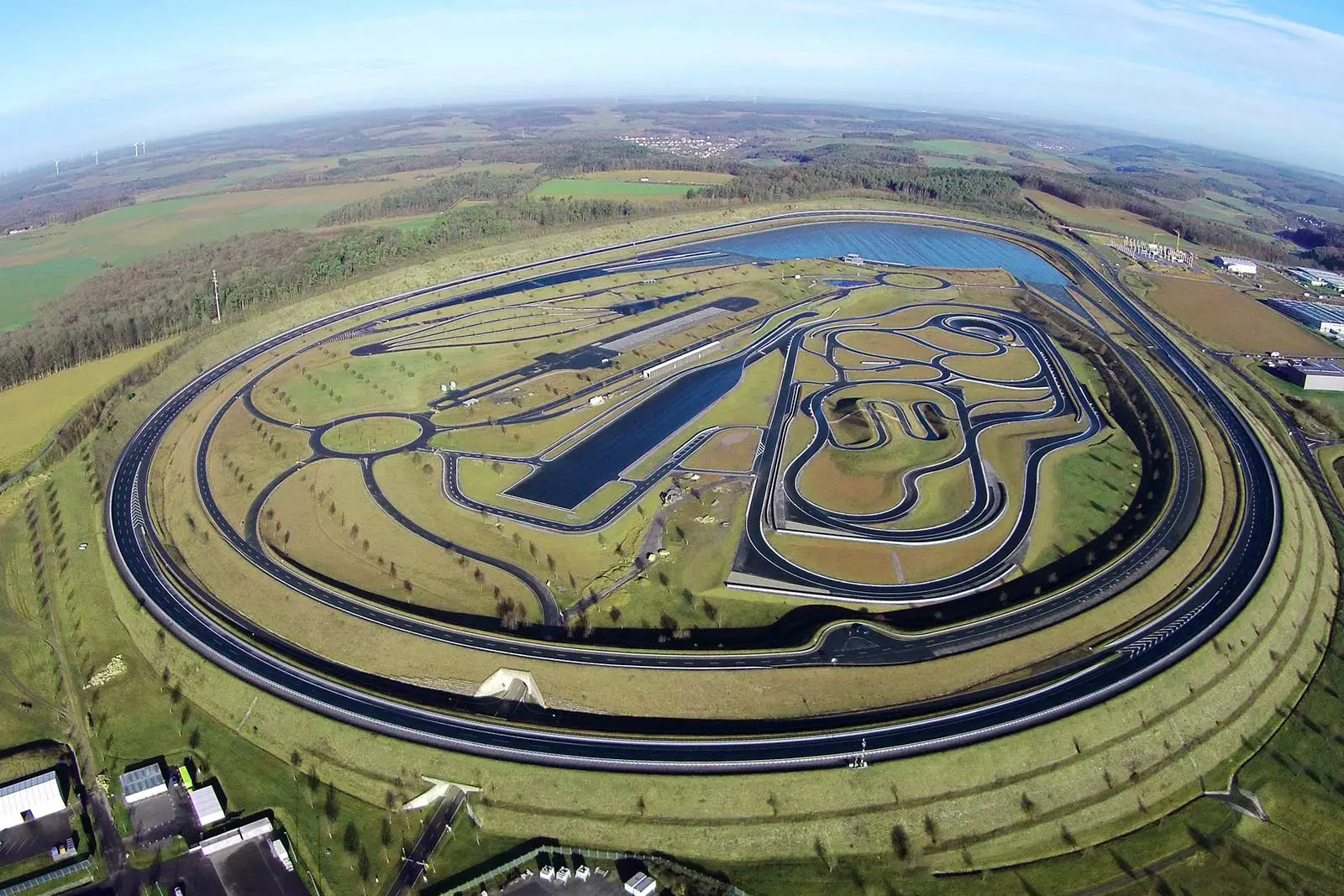
If you want to build the underlying car control first, the driver training at the Boxberg test and proving centre is the place for it: load changes and wet surfaces can be repeated as often as you like there, without a mistake costing anything.
Conclusion
The Grand Prix circuit is where progress comes fastest at the Nürburgring: short enough to grasp in a day, demanding enough to keep refining for years. Add assigned sessions, coaching and a fleet that can be provided in full.
All upcoming dates are in the track day overview. Our track day FAQs answer the rest.
Want to give a track day as a present? An ESC voucher works for anyone who takes motorsport seriously.
Questions about your first track day? Get in touch – and read what our participants say.
Frequently Asked Questions about the Nürburgring Trackday (FAQ)
It depends on the format: a track day on the Grand Prix circuit is costed differently from the AFTERWORK format in the late afternoon or a date on the Nordschleife. On top of that comes whether you drive your own car or add a vehicle through CarForGo. The current price and the services included are shown with the individual event – what counts is that event description and our terms and conditions.
No. At our track days you normally run in the STREET session with your road-legal sports car – whatever the make. If you do not have a suitable car, or would rather not use your own, you can add a vehicle through CarForGo, from a road-going sports car to a clubsport racing car.
On tourist drives you share the circuit with an open field of very different vehicles and drive without support. On a track day the running is in assigned groups with a limited number of cars, there is a drivers' briefing and coaching throughout the day. Which services are included on your date is set out in the event description.
It is considerably quicker to get to grips with. The Grand Prix circuit measures 5.148 kilometres with 15 corners and can be worked out in a day. The Nordschleife runs to 20.832 kilometres and 73 corners – drivers refine that over years. For a first track day the Grand Prix circuit is the obvious choice.
Whether your own comprehensive policy covers damage on a circuit is something you should have confirmed in writing – many policies exclude events on closed circuits. ESC's organiser liability normally covers participant liability, and for many dates we offer an optional ESC comprehensive guarantee on top; an excess still applies. What counts is the description of your individual event and our terms and conditions.
Yes. Through CarForGo, ESC brings the car to the circuit fully prepared, normally including insurance, brake and tyre wear and a mechanic on site. The choice runs from a road-legal sports car to a clubsport racing car. Which cars are available on your date is shown when you book and in the fleet overview.
A vehicle check (brake pads, brake fluid, tyres, fluid levels), sorting out a helmet – a helmet is mandatory on the circuit, and one can be hired through us on request –, comfortable closed shoes, long clothing and enough sleep. On site the day starts with scrutineering and the drivers' briefing.
Yes. On German circuits the limit is usually 98 dB; abroad it differs – normally 100 dB at the Red Bull Ring and 103 dB at Spa-Francorchamps. Every circuit works to its own noise allowance across the year, so there is no single figure. If you run an aftermarket exhaust, check the figure that applies to your date before booking; the event description is what counts.
On most dates coaching, the overnight stay on the day of arrival in a single room and cold snacks plus a hot meal on the track day are included; a service team is normally on site. For many dates there is also free rebooking, typically once, up to eight days before the event. Which services apply to your date is set out in the event description and in our terms and conditions.
The season essentially runs from spring to autumn. May and September are often more pleasant than the height of summer – moderate temperatures are easier on tyres and brakes. Anyone going out on track for the first time has a simpler job of it in dry conditions.
Still have questions?
Contact our team — we'll help you find the right cover for your next track day. Or sign up for our exclusive ESC newsletter and stay up-to-date!