





Trackday Hockenheimring: Experience the Former F1 Circuit


Where Schumacher, Senna, and Räikkönen battled for victories, you can now push to the limit yourself. The Hockenheimring is more than a race track, it's a piece of motorsport history. And the best part: you don't need a racing license for a trackday here.
If you're planning a trackday in Germany, the Hockenheimring belongs on your list. The former Formula 1 circuit offers the perfect mix of high-speed passages and technical challenges, with high safety standards including FIA Grade 1 certification and large runoff areas.
In this guide, you'll learn everything about the Hockenheimring: the legendary corners, what to expect at one of our trackdays, the STREET and RACE windows, practical info about getting there, and how you can access this traditional race track with the European Speed Club, with your own car or with a sports car from our fleet.
→ Discover ESC Trackday Dates 2026
Track Overview
The Hockenheimring Baden-Württemberg is located south of Mannheim in the Kurpfalz city of Hockenheim. Since its opening on May 29, 1932, the track has undergone a remarkable transformation, from the 12-kilometer triangular course through the Hardtwald forest to today's modern 4.574 km Grand Prix circuit.
Hockenheimring Track Data:
| Specification | Value |
|---|---|
| Track Length | 4.574 km (Grand Prix circuit) |
| Track Width | 12 to 18 meters |
| Corners | 17 (6 left, 11 right) |
| FIA Certification | Grade 1 (Formula 1-capable) |
| Noise Limit | usually 98 dB(A) at ESC trackdays |
| Opening | May 29, 1932 |
Today's Grand Prix circuit was completely rebuilt in 2002. The original high-speed track with its long forest straights was drastically shortened. Instead, a technically demanding course emerged with the characteristic Motodrom, a stadium-like section with tight corners and views of the grandstands.
The Legendary Corners
The Hockenheimring combines high-speed passages with technical corner combinations. That's what makes it so fascinating and so demanding.
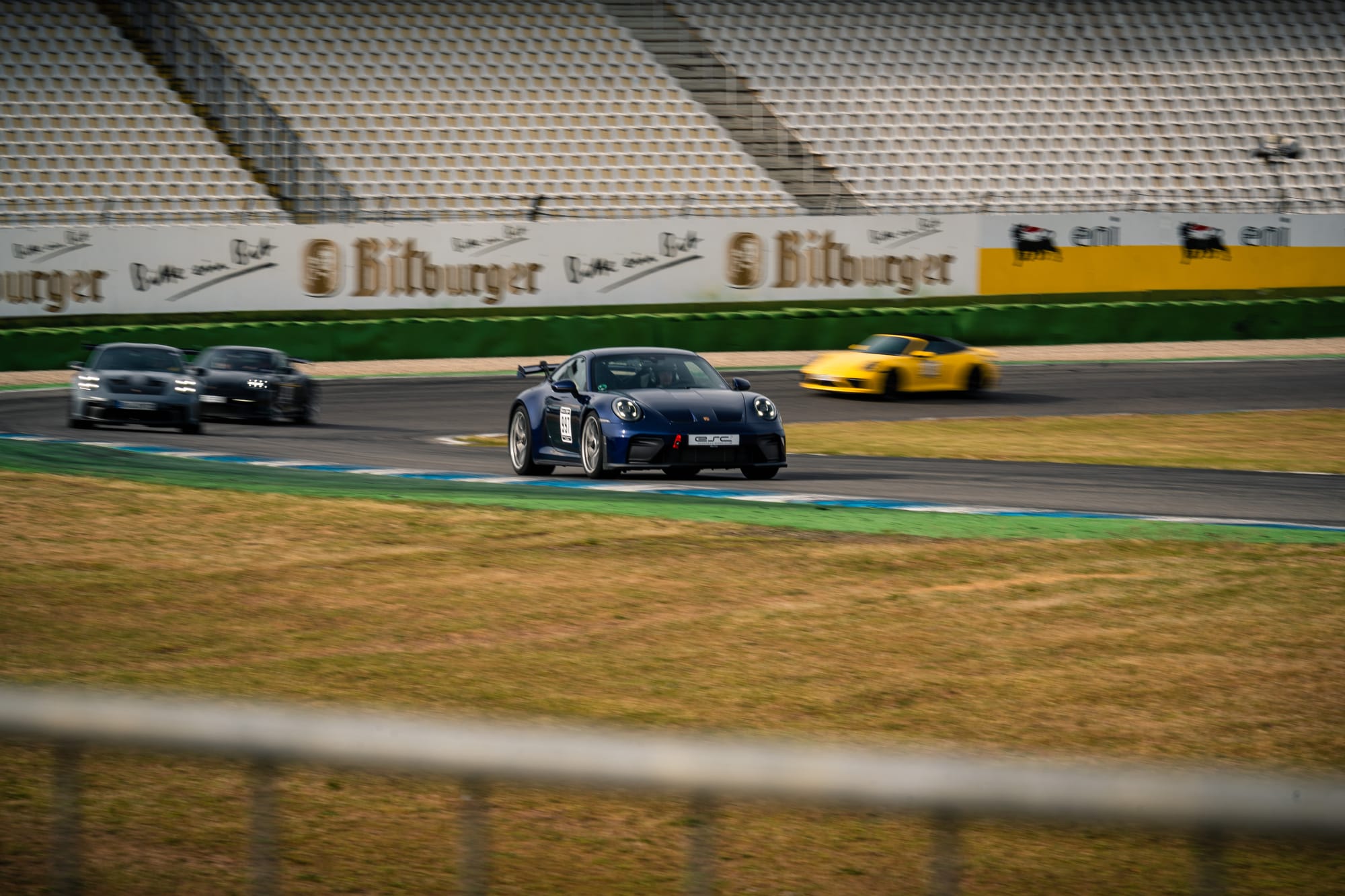
The Spitzkehre: Overtaking Paradise
At the end of the long Parabolika, Formula 1 cars reached speeds of up to 330 km/h. Then comes the hardest braking point on the track: the Spitzkehre. A tight right-hand hairpin of around 170 degrees taken at under 80 km/h. The speed reduction is extreme, and this is exactly where the most spectacular overtaking maneuvers happen.
The approach to the Spitzkehre is pure adrenaline. You brake from high speed into one of the slowest corners on the course. It demands precise braking, clean downshifting, and the courage to brake later than instinct allows. A real challenge for newcomers to the track, and often the highlight of the day for experienced drivers.
The Sachskurve: Pure Technique
The Sachskurve in the Motodrom is a long left-hander of around 180 degrees that has always been considered technically demanding. A lot of time can be gained or lost here. The special feature: the outside line is often faster than the classic racing line. This requires trust in the car and in the coaching.

At an ESC trackday, experienced instructors show you how to approach the Sachskurve. Because here it becomes clear who truly understands their car.
The Motodrom: Stadium Atmosphere
The entry into the Motodrom is considered one of the most difficult passages of the course. You arrive at high speed and have to place the car cleanly into the tight corners of the stadium section. Carry too much speed and you quickly lose the line.
The Motodrom itself offers something unique: stadium atmosphere on the race track. The grandstands around you, the feeling of driving where Formula 1 once raced. An experience that other tracks can't offer in this way.
Additional Key Corners
| Corner | Characteristics | Tip |
|---|---|---|
| Parabolika | Long full-throttle passage | Courage for late braking |
| Südkurve | Right-hander before the start-finish line | Accelerate cleanly onto the main straight |
| Ravenol Corner | Technical combination | Patience on acceleration out |
| Bernie Ecclestone Corner | Named after the former F1 boss | Clean line before speed |
History: From Test Track to F1 Legend

The history of the Hockenheimring begins in 1932. The idea came from Ernst Christ, a young timekeeper from Hockenheim. An approximately 12 km triangular course was laid out on forest paths in the Hardtwald, and the first motorcycle race started there on 29 May 1932.
The Transformations
- 1938: Shortened to 7.7 km
- 1966: Reopening after highway construction (the A6 cut through the old track), new Motodrom
- 2002: Redesign to today's Grand Prix circuit (4.574 km)
The 2002 rebuild was controversial. The long forest straights, where speeds of around 350 km/h were reached, gave way to a more technical layout. For trackdays, this is a blessing: more corners mean more learning opportunities, and modern safety standards make the track more accessible.
Legends at the Hockenheimring
Niki Lauda, Ayrton Senna, Michael Schumacher: they all celebrated Grand Prix victories here. Kimi Räikkönen holds the official lap record from 2004 with 1:13.780, modern GT3 race cars run around 1:37, and if you drive your street-legal car under 2:00, you're already quite fast. The DTM also regularly visits the Hockenheimring.
What to Expect at a Trackday
A trackday at the Hockenheimring is more than just free driving. At the European Speed Club, a structured day awaits you that challenges newcomers to the track as well as experienced drivers.

Daily Schedule
The day begins with a comprehensive briefing. You learn about the track layout, flag signals, and rules of conduct. Then it's onto the track in groups, divided by vehicle and pace.
At ESC trackdays at the Hockenheimring, two groups usually alternate, with up to 20 sports cars per group and typically five sessions of 40 minutes each. Between sessions you have time to process what you've experienced, talk to your coach, and check your vehicle. There are also AFTERWORK dates in the late afternoon. They run as open pitlane with free entry and exit, usually with up to 30 sports cars.
STREET and RACE: Which Window Suits You?
On the big circuits, ESC splits the trackday into two windows. What matters is not only the vehicle, but above all the pace. A cautious driver in a race car on slicks is often no faster than a trained driver in a road-going sports car.
| Window | For whom | Coaching |
|---|---|---|
| STREET | Street-legal sports cars, from your first trackday to experienced drivers. Also CarForGo vehicles and private coaching in your own or a provided sports car. | Group coaching usually included |
| RACE | Race cars on slicks, the GT4 Clubsport race car from the CarForGo fleet, and very fast drivers in road cars, such as a GT3 RS. | Coach available as an option |
At Nordschleife events, the windows are called STARTER and EXPERT, because race cars are not permitted there. Read more in our Trackday Nordschleife guide.
Requirements
- Driver's License: A valid car driver's license is mandatory
- Helmet: Helmets are mandatory on the race track. Whether a loan helmet is available for your date is best checked with the ESC team in advance
- Vehicle: Your own street-legal sports car, a vehicle from our CarForGo fleet, or a race car in the RACE window
- Noise Limit: ESC trackdays at the Hockenheimring usually have a limit of 98 dB(A). Check your vehicle beforehand
How to get your car ready for the day is covered in our trackday preparation guide.
Suitable For Whom?
The Hockenheimring is suitable for drivers of all experience levels. Wide runoff areas and modern safety facilities give you room to learn. The technical corners offer plenty of learning potential for newcomers. And the high-speed passages challenge even experienced trackday drivers.
If you'd like to work on car control before your first race track, the Boxberg proving ground is the right place. The Perfektion training at Boxberg covers everything from your first time to the fine-tuning, drifting included, and combines well with coaching on the race track.
Trackday at the Hockenheimring: Your Options
Several organizers offer trackdays at the Hockenheimring. The differences lie mainly in group size, coaching, and service level. Here's what to look out for when comparing:
- Group size: How many vehicles are on track at the same time? Small groups mean more free laps and fewer interruptions.
- Coaching: Is coaching included, or only available for an additional fee?
- Vehicle: Can you only drive your own car, or are prepared rental vehicles with insurance available?
- Services: Are hotel, catering, and trackside support part of the package?
With Your Own Sports Car
Many of our guests come with their own sports car, and the Hockenheimring is a great choice for it. You know your car and get to find out what it's really capable of on track. Plan for higher wear on tires and brakes, and check beforehand how your car is insured on the race track. More on this in our trackday insurance guide.
With the ESC Package
At ESC trackdays, you drive in small groups, usually with up to 20 sports cars per group. In the STREET window, group coaching from instructors with motorsport backgrounds is usually included. On top of that, you have the option to drive a CarForGo vehicle. Trackdays usually come with a rebooking guarantee, and a comprehensive cover guarantee is available as an option.
What a Trackday at the Hockenheimring Costs
The cost of a trackday at the Hockenheimring depends mainly on three things: whether you drive your own sports car or a CarForGo vehicle, whether you book the STREET or the RACE window, and which services are part of the package, such as coaching, hotel, or comprehensive cover. With your own car, fuel and wear come on top. With the CarForGo package, insurance with a fixed deductible and wear are usually included, and you usually pay for the fuel you use yourself. You'll find current prices for each date in the event calendar.
→ ESC Trackday Dates at the Hockenheimring
Trackday Without Your Own Car
You don't own a sports car, or you'd rather leave yours in the garage? Understandable. The strain on brakes, tires, and clutch on a race track is significantly higher than in everyday use.

The solution: CarForGo. ESC provides you with a prepared sports car from its own fleet. It consists mostly of Porsche models, from the 718 Spyder to various 992 models up to the GT3 RS and the GT4 Clubsport race car. The fleet also includes sports cars from other brands such as Corvette and BMW. So there's the right car for every experience level. Which vehicles are available for your date is listed with each event.
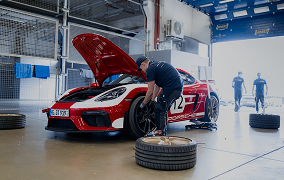
The vehicles are prepared in our in-house workshop Paddock 7, so you get into a car that's ready for the track. Insurance with a fixed deductible is usually included in the package, and you know the amount before you book. You usually pay for the fuel you use yourself. For the GT4 Clubsport packages and for CarForGo vehicles at Boxberg, it is usually already included.
→ Discover the ESC Fleet or read our guide Trackday Without Your Own Car
Practical Information
Directions
The Hockenheimring is conveniently located in Baden-Württemberg:
- From Frankfurt: approx. 80 km (45 min.) via A5/A6
- From Stuttgart: approx. 100 km (1 hr.) via A8/A6
- From Munich: approx. 320 km (3 hrs.) via A8/A6
- Address: Am Motodrom, 68766 Hockenheim
The Hockenheim highway exit leads directly to the race track, so directions couldn't be simpler.
Accommodation
For a relaxed trackday, we recommend arriving the evening before. Hotels directly at the ring are ideal. Alternatively, Heidelberg is only about 20 minutes away and offers a beautiful old town.
At ESC events, participants often stay together, and for many, the exchange with like-minded people in the evening is one of the best parts of the experience. Good to know: at many ESC trackdays, accommodation is already part of the package. What applies to your date is set out in the event description.
Weather Tip
The Hockenheimring is located in one of the warmest regions of Germany. In summer, the asphalt can get extremely hot, which puts additional strain on tires and brakes. Spring (April/May) and autumn (September/October) often offer the best conditions.
Your Path to a Hockenheimring Trackday with ESC
Want to experience the fascination of the Hockenheimring yourself? At an ESC trackday, you get more than just track time:
- Professional Coaching: Instructors with real motorsport backgrounds, group coaching usually included in the STREET window, optional in the RACE window
- Small Groups: usually up to 20 sports cars per group
- CarForGo Option: prepared sports cars from the ESC fleet, insurance and wear usually included in the package
- Network: Exchange with like-minded people and motorsport enthusiasts
- Clear Services: What's included is set out in the description of your date before you book
Check out the experiences of our participants or take a look at our image gallery for impressions from past events. Answers to common questions are in our trackday FAQs.

Secure one of the limited spots
Discover the ESC trackday dates at the Hockenheimring and experience the former F1 circuit up close. If you have questions, our team is happy to help: contact us for personal advice.
Book Trackday Now →
The services, deadlines and cover that apply to your specific date are set out in the description of the individual event and in our terms and conditions, which take precedence.
Sources & Further Information
- Hockenheimring Baden-Württemberg: official track information and track data
- ESC Trackdays: all tracks, formats and current dates
Frequently Asked Questions
Both tracks have their strengths: the Hockenheimring scores with clear sightlines and large run-off areas.
Formula 1 charges circuits high hosting fees. Without state support, the race no longer paid off for Hockenheim, and the last German Grand Prix there was held in 2019. The circuit itself still meets Formula 1 standards with an FIA Grade 1 licence. At an ESC track day you drive exactly this Grand Prix circuit, in the STREET or the RACE slot.
That depends on the kind of damage. ESC's organiser liability insurance usually includes participant liability cover, which applies to damage caused to third parties. Damage to your own car is usually only covered if you have hull (comprehensive) cover. Many car insurers exclude driving on a race track, so check with your insurer beforehand. For track days, comprehensive cover can be added depending on the date. If you drive a car from the ESC fleet via CarForGo, an excess applies. Damage to the circuit, for example to crash barriers, is usually charged to whoever caused it by the circuit operator. More in our article on track day insurance. The services, deadlines and cover that apply to your specific date are set out in the description of the individual event and in our terms and conditions, which take precedence.
Yes, but it depends on the specific event.
Since 2024 it has been held by emodrom group holding GmbH.
The fastest Formula 1 lap time is around 1:13, modern GT3 race cars run roughly 1:37, and if you're under 2:00 in your road-legal car you're already going pretty quickly.
The Grand Prix circuit of the Hockenheimring has 17 corners over 4,574 metres, 6 left-handers and 11 right-handers. The best known are the hairpin at the end of the Parabolika and the Sachs curve in the stadium section.
Yes. The easiest way is a track day: the circuit is reserved for registered participants, you do not need a racing licence, a valid driving licence is enough. With ESC you usually drive at the Hockenheimring in the STREET and RACE windows, with group coaching in the STREET slot. Helmets are mandatory on the track. You bring your own car or, depending on the date, book a car via CarForGo. All dates are in the event calendar.
F1-CEO Stefano Domenicali hat eine Rückkehr nicht ausgeschlossen. Mit den neuen Investitionen der emodrom group und Modernisierungen könnte Hockenheim wieder attraktiver werden. Unabhängig davon kannst du schon heute auf dieser legendären F1-Strecke bei Trackdays fahren.
In Deutschland bieten mehrere Rennstrecken Fahrerlebnisse an: Der Hockenheimring
Still have questions?
Contact our team — we'll help you find the right cover for your next track day. Or sign up for our exclusive ESC newsletter and stay up-to-date!